
In everyday clinical practice, patients are often referred with the label “too complex”. Severe bone loss. Multiple missing teeth. Failing implants. Collapsed bite. Long-term infection. Years of postponed treatment. However, what defines a complex dental case today is very different from what it meant twenty years ago. Modern implant dentistry has significantly expanded the range of treatable situations – provided that diagnosis, planning and execution are performed at a high clinical level. At White City Dent, complex rehabilitation is approached systematically, through interdisciplinary planning, advanced diagnostics and carefully structured treatment phases.
What actually makes a case complex?
A dental case is typically considered complex when it involves a combination of biological, functional and restorative challenges.
These may include:
● advanced bone resorption following long-term tooth loss
● peri-implantitis or failed implants
● multiple failing crowns and bridges
● bite collapse due to worn dentition
● loss of vertical dimension
● chronic inflammation or untreated periodontal disease
In many situations, the complexity does not lie in a single problem, but in the interaction between several of them. That is why comprehensive diagnostics are essential not only to identify limitations, but to uncover realistic treatment possibilities.
The role of 3D diagnostics and digital planning
Contemporary implant rehabilitation relies on precision. CBCT imaging allows detailed evaluation of bone volume and anatomical structures. Digital
planning software enables prosthetically driven implant positioning. Occlusal analysis ensures long-term functional stability. At White City Dent, treatment planning is never improvised. Each complex case begins with
thorough analysis and a clearly defined clinical strategy. Complexity does not eliminate solutions, it simply requires higher precision and experience.
Severe bone loss: no longer an absolute limitation
One of the most common statements patients hear is: “There is not enough bone for implants.” While bone deficiency is a serious clinical factor, it is not automatically a contraindication.
Contemporary treatment options may include:
● bone grafting procedures
● sinus lift surgery
● short or angled implant protocols
● full-arch solutions such as All-on-4 or All-on-6
Each case must be evaluated individually. Careful staging, healing time and biomechanical planning are essential to achieving long-term stability.
Clinical example
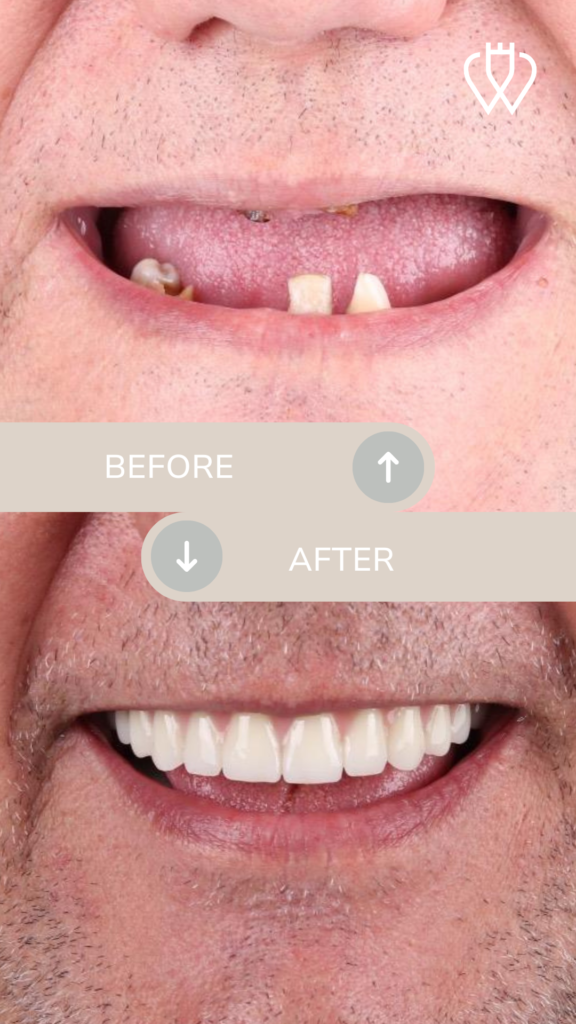
A UK patient presented with advanced bone loss in the upper jaw, two failing implants and multiple unstable crowns. She had previously been advised that predictable restoration
would be difficult.
Following comprehensive CBCT diagnostics and interdisciplinary consultation, a staged treatment plan was implemented:
● removal of failing restorations
● bone regeneration procedures
● guided implant placement
● full-arch prosthetic rehabilitation
Today, the patient has a stable, fixed solution with restored function, facial support and renewed confidence. Cases that initially appear untreatable often become manageable when addressed
methodically and without delay.
Revision dentistry: correcting previous failures
Revision cases are among the most demanding in implant dentistry. Failed implants, poorly distributed occlusal forces or inadequate prosthetic design can lead to long-term complications.
Successful correction requires:
● elimination of infection
● re-establishment of healthy tissue
● precise implant positioning
● prosthetic design that respects biomechanics
Experience in both surgical and restorative phases is crucial.
Why timely access to advanced care matters
For many patients in the UK, extended waiting times can allow conditions to progress further.
Delays may result in additional bone loss or worsening infection.
At White City Dent, international patients benefit from coordinated scheduling, immediate
diagnostics and structured treatment timelines allowing complex cases to be addressed
efficiently and predictably.
This is not about accelerating treatment unnecessarily. It is about preventing avoidable
deterioration and planning rehabilitation at the right moment.
Complexity does not mean impossibility
Modern implant dentistry has evolved considerably. What was once considered a contraindication may today be treatable through precise diagnostics, surgical expertise and
interdisciplinary planning. The key question is not whether a case is complex. The key question is whether it has been evaluated with the right tools, the right timing and the right
clinical experience. For many patients, that realisation is both reassuring and transformative.
A professional recommendation for patients with complex cases
If you have been told your dental situation is too complicated, too advanced or too risky, a second clinical opinion can often provide clarity.
Modern implant dentistry relies on detailed imaging and structured planning not assumptions. For patients considering evaluation, the first step is simple. A recent panoramic X-ray (OPG) or CBCT scan allows for an initial assessment of bone levels, existing restorations and overall oral condition. Based on this documentation, a preliminary treatment outline can be provided, including possible options and estimated
timelines. At White City Dent, international patients are guided through this process in a structured and transparent way. Every case is reviewed individually, with realistic recommendations and clear explanations. Complex does not mean impossible. It means the case deserves careful evaluation. If you would like a professional assessment of your situation, you may send your panoramic X-ray and medical information for review. A detailed response will outline the available treatment pathways and help you understand the next steps before making any decision. Clarity is often the first and most important step toward restoration