
When patients are told they need a dental crown, it can feel like a straightforward solution:
the tooth is damaged, a crown is placed and the problem is solved. In reality, crowns are one of the most important restorations in dentistry. They don’t just
protect a tooth, they influence how you bite, how your smile looks and how comfortable your mouth feels every day. Over the years, we’ve seen how the same crown can perform very differently depending on how it’s planned and what it’s made of. Two crowns may look identical on the outside, yet behave completely differently over time.
That’s why we always take a moment to explain the bigger picture before talking about materials. Understanding why a crown is needed, and what it needs to do in your mouth, is just as important as choosing how it will look.
From there, the conversation naturally moves to materials because what’s beneath the surface plays a key role in how successful a crown truly is.
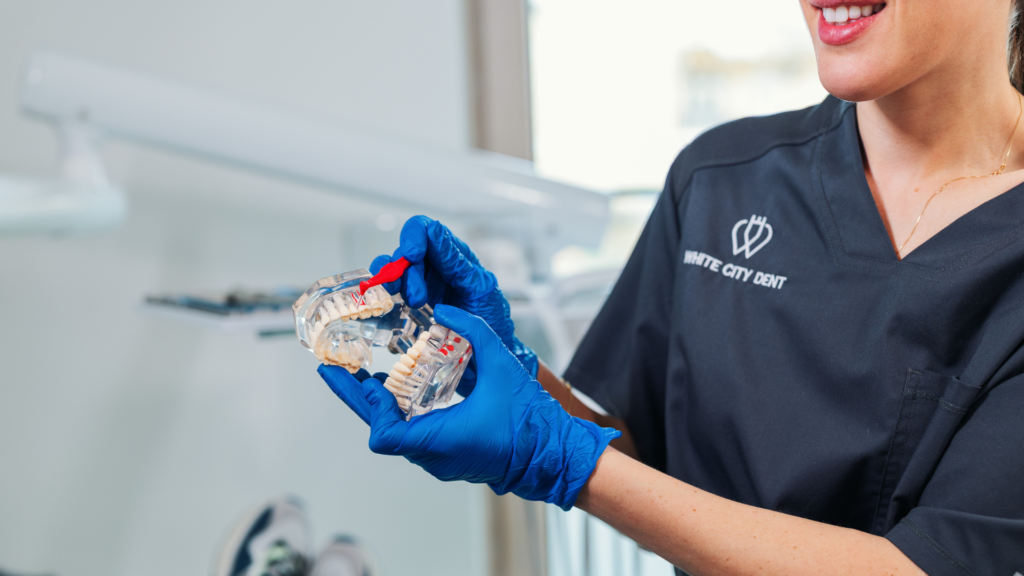
Metal-ceramic crown
This crown has a dark metal base, covered with ceramic. From the outside, the tooth looks white. On the inside, the structure is metal. In practice, this means:
● Good strength and long clinical history
● Over time, the metal can sometimes show through near the gum as a grey line
● Light does not pass through the crown naturally
We see these crowns less often today, mainly because patients prefer more natural-looking, metal-free options.
Zirconia-ceramic crowns
Zirconia is a white material, which means the crown is white both on the inside and outside.
This is one of the main reasons zirconia crowns look so natural.
In practice:
● Excellent strength
● Very good gum compatibility
● Natural light reflection and mild transparency
Zirconia-ceramic crowns imitate natural teeth extremely well, which is why they are widely
used today – especially for back teeth and bridges.
E.max crowns
E.max crowns are made of full ceramic, without any metal. Compared to zirconia, E.max is
more translucent, meaning it allows more light to pass through.
In practice:
● Outstanding aesthetics
● Very natural enamel-like appearance
● Limited ability to mask darker underlying tooth colour
Because of this, E.max is often used in the front teeth area, where appearance matters
most and bite forces are lower.
Our practical advice for patients
When we talk to patients about crowns, we always try to simplify things. Every crown you see is white but what truly matters is what’s underneath. That inner
structure is what determines how the crown will behave over time: how it handles pressure, how it ages and how naturally it blends with your smile.
This is why we never recommend materials based on trends or price alone. In real clinical life, the right choice depends on where the tooth is positioned, the natural colour of the tooth underneath, how strong your bite is and what you expect from your smile in the long run. At White City Dent, our recommendations are shaped by years of hands-on experience, not
theory. Our goal is simple: to help you choose a crown that will still feel right, look natural and function comfortably years after it’s placed.
That’s the perspective we bring into every consultation: honest, practical and always tailored to you.